
GamStop explained, the scheme, the periods, the checks
GamStop is a national self-exclusion database run under UK Gambling Commission licence conditions. Offshore Ledger UK reads it the way a policy analyst reads any register, that is, by asking who sits inside its scope, who sits outside, and what a comparable register in another jurisdiction is actually empowered to do. This page walks through the scheme itself, the three exclusion periods, the technical block, the twenty-four hour cool-off, the seven-year auto-extension, and the points at which the UKGC-anchored architecture stops reaching.
What GamStop is, plainly
GamStop is a national self-exclusion database operated by the National Online Self Exclusion Scheme Limited, a not-for-profit set up by the UK gambling industry under a formal requirement written into UK Gambling Commission licence conditions. It went live in April 2018 and became mandatory for every UKGC-licensed remote gambling operator on 31 March 2020. Every operator that holds a remote licence issued by the Commission now sits under a licence condition to query the GamStop register at the point at which a new customer registers, and again at the point at which that customer attempts to deposit. If the record returned by GamStop shows an active self-exclusion, the operator's system must refuse the registration or refuse the deposit. The scheme is therefore not an add-on tool that a player chooses whether an operator uses. It is a compliance requirement written into the licence itself, sitting at the same tier as the operator's obligation to know its customer, to segregate customer funds and to co-operate with a UK-side complaints route.
This is the point at which comparison with foreign self-exclusion registries becomes useful. Denmark's ROFUS, the Swedish Spelpaus, the Dutch CRUKS and the Spanish RGIAJ are all national self-exclusion registers, but each rests on the licence conditions of its own regulator. A register only reaches the operators whose regulator can compel them to query it. Curacao under the Landsverordening op de Kansspelen has no equivalent database. Anjouan has none. The Malta Gaming Authority operates a limited self-exclusion facility for MGA-licensed sites only, and the Gibraltar Regulatory Authority operates a smaller equivalent for Gibraltar-remote licensees. None of these reach a UK GamStop registration, and GamStop does not reach them. Self-exclusion is a jurisdictional instrument, not a global one, and that is the design fact the rest of this page turns on. A UK adult who has registered on GamStop has excluded themselves from the UKGC-licensed tier of operators. The scheme's reach is defined by that licence tier and it does not extend beyond it, because the technical architecture is not built to.
02The three periods, and what each commits you to
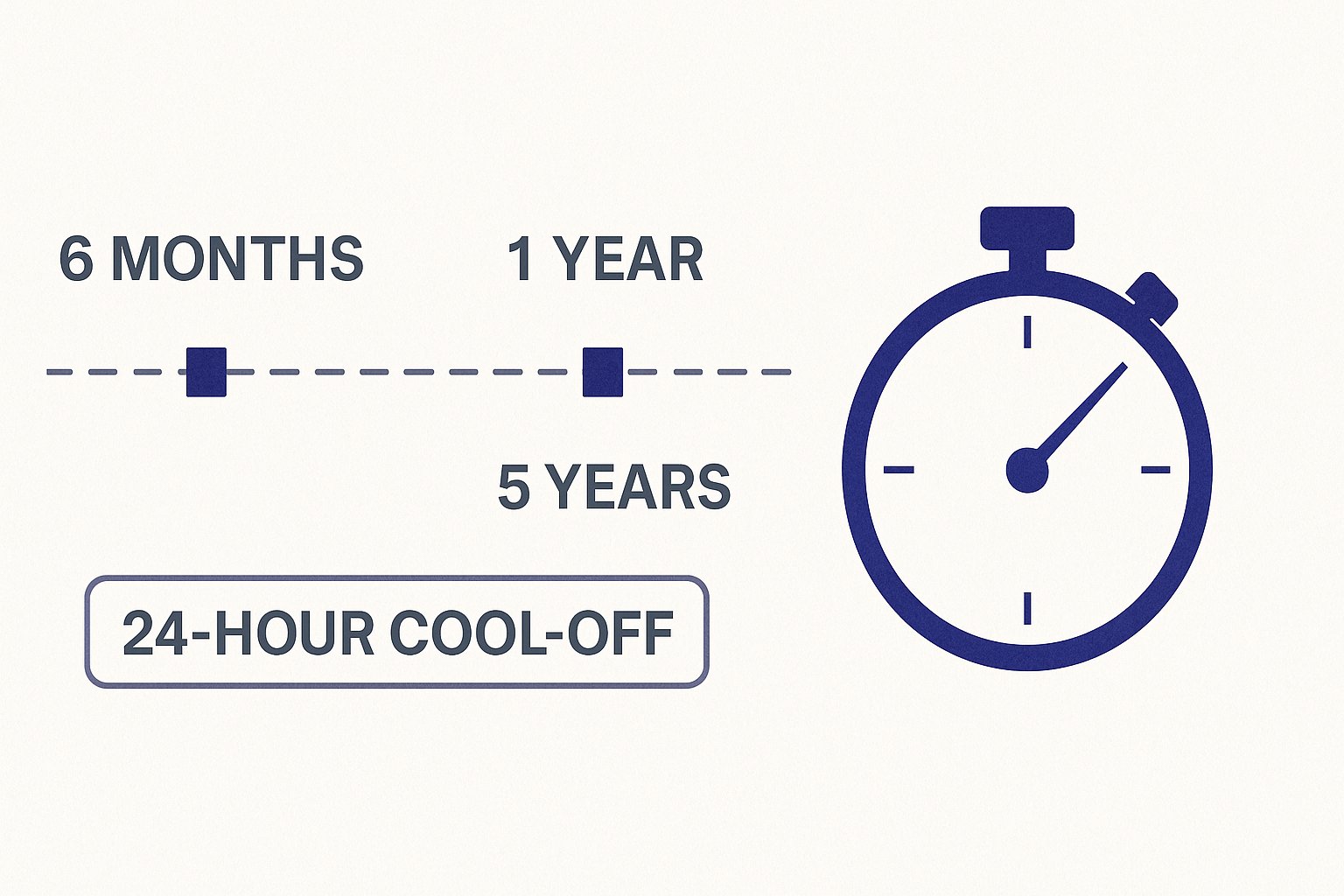
A registrant chooses one of three exclusion periods at sign-up, that is, six months, one year, or five years. The choice is binding for the duration selected. GamStop does not offer a way to shorten a live registration, and there is no back-office capacity for an operator, a third party or the scheme itself to lift the block early. The design intent is not punitive. It is a protection against the moment-of-crisis reversal that comes hours after a person has excluded themselves. The evidence base drawn on by the scheme's designers, published across the UK gambling harm literature and picked up in the design work behind comparable schemes in Sweden, Denmark and the Netherlands, is that a short and reversible exclusion is a materially weaker instrument than a fixed exclusion which a person cannot cancel in the same twenty-four hours in which they set it up. The three-tier structure gives a registrant a graduated way to match commitment to circumstance.
The six-month period is the entry level and is used most often by registrants who are trying self-exclusion for the first time. The one-year period is chosen by registrants who have decided the six-month exposure to a re-registration decision at the far end is itself a risk. The five-year period is the strongest instrument in the scheme and is chosen by registrants who want the decision to sit in the far background of daily life. All three periods are administered identically once active. The difference between them is only the length. The Commission has published no guidance suggesting one period is more effective than another; length is a personal judgment a registrant makes at the outset, informed by the scheme's own advice to choose the length that a registrant thinks they will hold to, not the length they think they should be able to hold to. That distinction sounds small on paper. It is the whole of the design conversation once a registrant is inside the sign-up flow.
A closer look
The three periods sit on top of an underlying design assumption that the scheme itself does not label but a reader can infer, that is, that a registrant is being asked to make a decision for a future self who may not still want the decision made. That is the same design assumption that sits under advance directives in medical ethics and under fixed-term commitment devices in behavioural economics. GamStop is a commitment device. It does not carry a psychological label because a public information scheme cannot carry a psychological label, but the mechanism is the same, and reading it as such is the shortest route to understanding why the periods look the way they do. It also explains why an unconditional early-cancellation route was never built. A commitment device that a person can cancel in the moment they most want to cancel it is not a commitment device.
03How the block reaches every UKGC-licensed site
The technical architecture behind the block is straightforward but underappreciated. Every UKGC-licensed remote gambling operator holds a licence subject to Social Responsibility Code Provision 3.5.5 in the Commission's Licence Conditions and Codes of Practice, which requires the operator to participate in the multi-operator self-exclusion scheme in force at the time. That code provision is enforceable as a licence condition, which means a failure to query the register at registration and deposit is a licence breach for which the Commission has both regulatory and financial enforcement powers. The register itself sits as a real-time database that operators query via an API call. Each query returns a match state that the operator's registration or deposit system must respect. A registrant does not have to lodge exclusion at each operator separately, because the licence condition binds every operator to the same central database and every operator to the same query obligation.
The reach of the block is therefore identical to the reach of the licence condition. It covers every remote gambling operator licensed by the UK Gambling Commission, and it covers nothing else. That includes the operator's white-label sites licensed under the same Commission licence, and it includes brands operating on a business-to-business software licence where the customer contract sits with a UKGC-licensed remote operator. It does not include an operator whose licence sits with the Curacao Gaming Authority, the Anjouan online gambling regulator, the Malta Gaming Authority, the Gibraltar Regulatory Authority, or any other regulator. Those operators sit outside the scope of the licence condition and outside the technical architecture that flows from it, and the register is not visible to their systems. That is the border across which non-GamStop searches happen. It is a border of licence, not a border of geography, and reading it as a licence border is the useful reading.
04What happens when your period ends
A registration reaches its expiry at midnight on the date recorded in the registrant's file, which is calculated from the date on which the exclusion became active rather than the date on which the registration was submitted. The system does not automatically remove a registrant on expiry. Instead, it moves the record into a post-expiry state in which the registrant is now able to take an action to bring the exclusion to a close, but the exclusion itself continues to be respected by every operator query until that action has been taken. The design here is deliberate. A registrant who has crossed the finish line of the period they chose is not returned to unfiltered access by default. Access sits behind a twenty-four hour cool-off window that a registrant must actively step through.
Between the expiry date and the moment at which access resumes, the registrant contacts GamStop directly, indicates that they wish to end the exclusion, and confirms the identity information held on their record. The cool-off then runs, and once it has passed, the record is closed and the block is lifted at the next UKGC-licensed operator query. If the registrant does not contact GamStop at all, the record does not close. It continues to run, and after a period defined by the scheme it extends automatically. That automatic extension is the piece of the scheme that a registrant is least likely to have read at sign-up, and the piece that most often takes a registrant by surprise at the point at which they had assumed the exclusion had lapsed. The next two sections walk through the cool-off and the auto-extension in turn, because each is a separate design decision and each carries its own consequences.
Key points
- The block runs off UKGC Licence Conditions and Codes of Practice, provision 3.5.5
- The register does not close automatically on expiry; the registrant has to step out actively
- Foreign self-exclusion registers such as CRUKS and ROFUS do not talk to GamStop
- An operator has no back-office switch to lift a live registration
- Related reading: see Coming off GamStop for the active-step-out route
The twenty-four hour cool-off explained
The twenty-four hour cool-off is the shortest of the design pauses built into the scheme, and the one most often misread as a bureaucratic delay. It is not bureaucratic. It is a reflective pause that draws on the same body of evidence that underpins the fixed-period design, that is, that a registrant coming off an exclusion who is intercepted by even a short reflective window is materially less likely to return to harmful play. Twenty-four hours is enough to move a registrant off the immediate impulse that arrived on the expiry date and long enough to allow at least one full daily sleep cycle to sit between the decision to end the exclusion and the moment at which access resumes. The window is not a screen for anything else. It is not a queue and it is not a review. It is simply time, held in place by the scheme's own workflow.
There is no way to compress the cool-off, and no operator can grant an exemption from it, because it is administered by GamStop rather than by any operator. During the twenty-four hours the registrant's file has already left active-exclusion status, which means that new deposits at UKGC-licensed sites are not yet possible but the operator system will see the file as closing rather than as active. When the cool-off expires the operator query returns a clean record and access resumes at UKGC-licensed sites on the next attempt. It is worth noting that the cool-off is a UK-side concept that has no direct parallel in the Curacao, Anjouan, MGA or Gibraltar frameworks; because those regimes do not operate a national self-exclusion register on the GamStop model, they do not have a cool-off to sit at the end of one. That absence is a design consequence of the register's absence, not an oversight.
A closer look
The twenty-four hour cool-off carries an implicit second function that is worth naming. Because it requires the registrant to contact GamStop actively rather than relying on the scheme to close the record automatically on expiry, it converts the end-of-period step from a passive default into an active one. That inversion is the same behavioural device that changes organ-donation registration rates when a country moves from opt-in to opt-out. GamStop applies the same idea to exclusion. The default at expiry is that the exclusion continues; the opt-in step to close it is an act that the registrant has to choose to take, on their own initiative, inside a defined window. That is not a bureaucratic delay. It is a design that reads exclusion as the safer default when the registrant is silent, and the reader who understands that reading will find the seven-year auto-extension in the next section entirely consistent with it.
06The seven-year auto-extension nobody warns you about
If a registrant takes no active step to close the record at expiry, the scheme extends the exclusion by a further seven years automatically. The seven-year figure is drawn from the scheme's design specification and is not visible on the standard registration page in the way that the six-month, one-year and five-year figures are visible. This is not a hidden clause in a legal sense; it is documented in the scheme's own terms and appears in the registration confirmation record. It is, however, invisible in the sense that a person who has come to the end of their exclusion period without reading the terms again is unlikely to remember it. The design intent is that a registrant who has chosen exclusion and then falls silent should be kept inside the exclusion until they actively step back out, on the grounds that a person who is silent at the far end of a five-year self-exclusion is more likely to have wanted to remain excluded than to have wanted the exclusion lifted.
The auto-extension does not stack. If a registrant lets the seven-year extension run and then falls silent again, the scheme does not add a second seven years on top of the first. The extension is a single instrument that runs from the original expiry, and at the end of it the same active-step-out route applies. A registrant who wants to close the record earlier than the end of the extension can do so at any point during the seven years by contacting GamStop and completing the cool-off; the extension is not itself a fixed-period exclusion in the way the original registration was. It is more accurate to read it as a rolling default that continues the block until the registrant makes an active choice to end it. That distinction matters at the moment at which a registrant wants to end the exclusion and is worried that the extension might be as binding as the original period. It is not, and it is closable at any point through the same route as the original.
GamStop and the wider harm-reduction picture
A self-exclusion register is one instrument in a wider harm-reduction toolkit, and reading GamStop as if it were the whole toolkit is a common misstep in policy discussion. The National Health Service now operates a network of gambling clinics under the NHS Long Term Plan, with treatment referrals available directly and through GamCare. The National Gambling Helpline on 0808 8020 133 sits as the front door to the whole treatment layer. BeGambleAware funds the helpline through the GambleAware charity and hosts self-assessment tools that a person can work through in private. GamAnon supports family members whose relative is gambling. The statutory levy that took effect on 6 April 2025 under the Gambling Levy Regulations 2025 now funds a share of the treatment, education and research pipeline at the state level. GamStop is the exclusion instrument inside that picture; it is not the treatment layer and it is not the research layer.
Read against foreign self-exclusion registries the same pattern holds. Sweden's Spelpaus sits inside a treatment system funded by the Swedish public health service. Denmark's ROFUS sits alongside the Danish gambling authority's stop-gambling helpline. The Netherlands CRUKS sits inside the Ksa's licensing regime for Dutch-licensed operators, with the treatment layer sitting under separate Dutch public health institutions. In every case the register is the exclusion instrument, and the treatment, education and research layers sit around it under separate institutions. Reading GamStop as a standalone measure, or as a solution to a problem larger than exclusion, misreads the design. Its job is to hold a decision the registrant has already made. The reader who wants a fuller picture should read the exclusion instrument alongside the treatment layer, not as a substitute for it.
08Common misreadings of the scheme
The single most common misreading is that GamStop is a criminal register. It is not. It is a compliance database maintained by a not-for-profit under UKGC licence conditions, and the only entities entitled to query it are the operators bound by those conditions. A GamStop entry is not visible to a bank, an insurer, an employer, a credit reference agency or a foreign regulator. The second most common misreading is that GamStop reaches every gambling site accessible from a UK address. It does not. It reaches every UKGC-licensed remote gambling operator and it reaches nothing else. The third is that a third-party removal agency can shorten a live registration. It cannot. There is no back-office route for such a third party to lift a block, and any agency claiming this is either misdescribing what it does or misunderstanding the scheme itself. The fourth is that a foreign self-exclusion registration transfers to GamStop. It does not; registers are jurisdictional instruments that do not share data across borders.
A fifth misreading, and one that Offshore Ledger UK sees on a rising trend line in reader queries, is that a VPN in some sense circumvents GamStop. It does not, for the reason that GamStop is not queried against a player's IP address but against the identity record supplied at registration. A VPN changes the network endpoint through which a page is being loaded; it does not change the identity data that a UKGC-licensed operator has to check against the register. The operator query still returns the active state and the deposit is still refused. A VPN is only a route around the register in the sense that it can present a page from a different geographical position; it is not a route around the licence condition itself, because the licence condition does not turn on IP geolocation. Reading GamStop against these five misreadings is the exercise that most often converts a partial understanding of the scheme into a working one, and it is the exercise every reader of this site is invited to walk through before moving to the offshore comparison in the next chapter.
Read next
- The legal position for UK players outside GamStop
- The risks, explained without the marketing
- Payments and checks, banks, cards, crypto, KYC
- Coming off GamStop, the official route
- Getting support, helplines, clinics, family, money
Sources and verification
Written from the primary source. GamStop scheme mechanics verified against the scheme's own published documentation and against the UK Gambling Commission Licence Conditions and Codes of Practice, specifically Social Responsibility Code Provision 3.5.5. Cross-checked against gamblingcommission.gov.uk. Last checked 5 August 2026.
Frequently asked questions
How does GamStop differ from a Swedish Spelpaus or Dutch CRUKS registration?
All three are national self-exclusion registers, but each rests on the licence conditions of its own regulator and reaches only the operators licensed there. GamStop reaches UKGC-licensed remote operators. Spelpaus reaches Swedish-licensed operators via the Spelinspektionen licence. CRUKS reaches Dutch-licensed operators via the Kansspelautoriteit. A registration on one register does not carry over to another, because the registers do not exchange data across borders.
Why can an offshore Curacao-licensed site accept a deposit from someone who is on GamStop?
Because the operator's licence sits with the Curacao Gaming Authority under the Landsverordening op de Kansspelen of 24 December 2024, not with the UK Gambling Commission. The GamStop query at registration and deposit is a UKGC licence condition and only applies to operators bound by UKGC licence conditions. A Curacao-licensed operator has no obligation to query the register and, in most cases, no technical access to it. That is a design outcome of the register being jurisdictional rather than global.
Does the seven-year auto-extension appear in the standard registration flow?
The three exclusion periods of six months, one year and five years are displayed at sign-up. The seven-year auto-extension is documented in the scheme's terms and in the registration confirmation record but is less visible than the initial period choices. It is enforced identically to a live registration for the seven years that follow the original expiry, and can be closed at any point in that window by an active step from the registrant.
Can a UKGC-licensed operator lift a GamStop block for a specific customer?
No. The register is centrally administered by the scheme itself, and an operator does not have back-office access to modify a customer's exclusion status. What an operator can do is refuse a registration or a deposit when the query returns an active exclusion. What an operator cannot do, under any circumstance, is set aside a live block for a specific customer at that customer's request.
Does GamStop share data with the Malta Gaming Authority or with a foreign regulator?
No. The register is a UK-side compliance database and does not exchange data with the MGA, the Gibraltar Regulatory Authority, the Curacao Gaming Authority or any other national gambling regulator. Foreign regulators do not have visibility into the register and cannot compel their licensees to query it. This is the design fact that puts non-UKGC operators outside the scheme's reach.
Talk to someone today
The National Gambling Helpline is free, confidential and open 24 hours a day, seven days a week.